

Body Mass Index (BMI) Calculator
Calculate BMI instantly using metric or imperial units
Select your preferred height and weight units, choose formula type, and view your BMI position in the standard health categories.Input details
BMI results
Underweight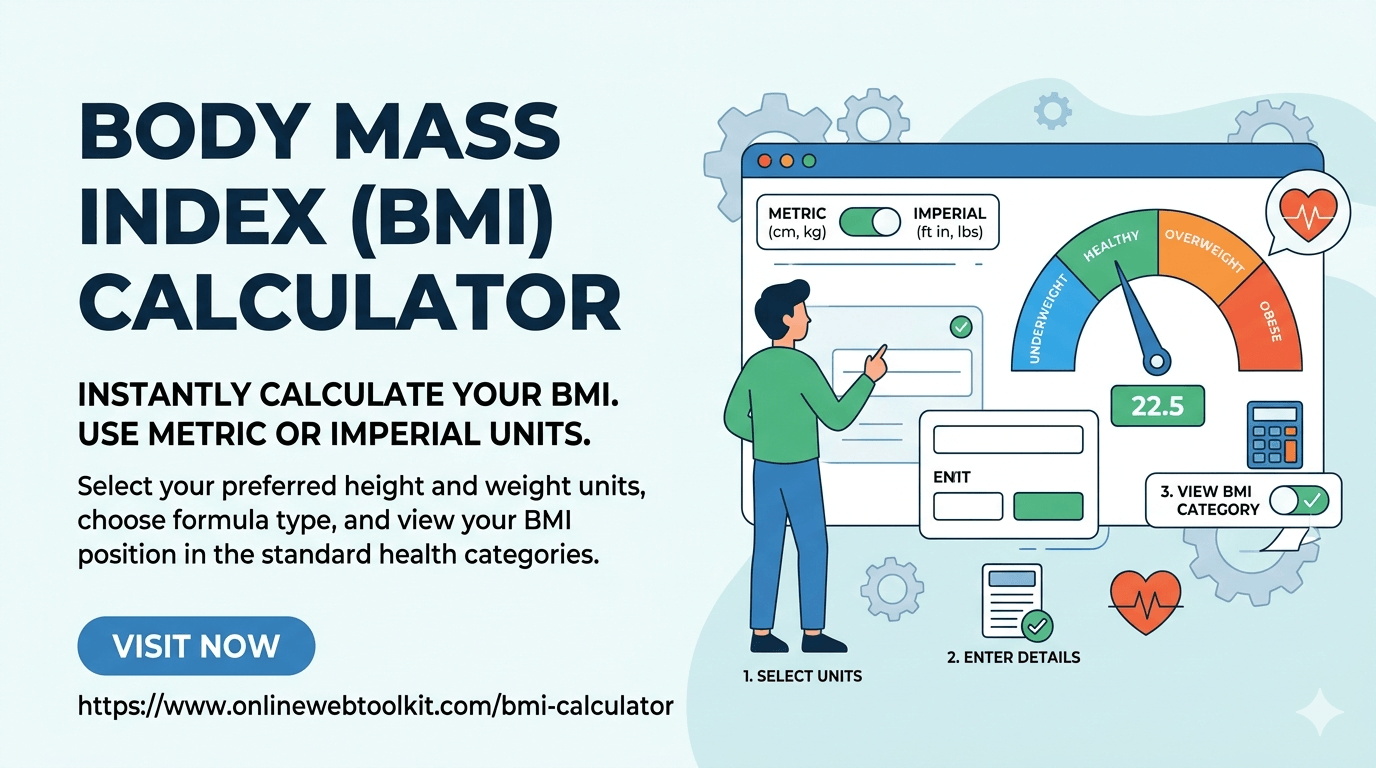
BMI Calculator: The Complete Guideto Body Mass Index
Everything you need to know about calculating, interpreting, and acting on your Body Mass Index — from formulas and charts to health risks, limitations, and the diabetes connection.
BMI Introduction: Why Body Mass Index Matters
In a world increasingly challenged by lifestyle diseases, obesity, malnutrition, and metabolic disorders, having a simple, reliable, and universally accepted method to assess body weight relative to height has never been more critical. The Body Mass Index (BMI) has emerged as one of the most widely used screening tools in modern medicine and public health — used by doctors, dietitians, researchers, insurance agencies, and health-conscious individuals around the globe.
Whether you are trying to lose weight, maintain a healthy lifestyle, manage a chronic condition like type 2 diabetes, or simply want to understand where your current weight stands on the health spectrum, a BMI calculator offers a fast, free, and accessible starting point. With just two inputs — your height and your weight — you can generate a number that opens a rich conversation about your personal health journey.
However, BMI is not a perfect tool. It is a screening measure, not a diagnostic one. Understanding what BMI can and cannot tell you about your health is just as important as knowing your BMI number itself. This comprehensive guide covers everything: the history, the formulas, the charts for adults and children, the health risks of both extremes, and the specific relationship between BMI and diabetes. By the end, you will be empowered to use BMI wisely as one piece in the broader puzzle of your overall wellness.
What Is BMI? Understanding Body Mass Index
Body Mass Index (BMI) is a numerical value derived from a person's weight and height. It is a widely used statistical measurement that provides an indirect assessment of body fat and is used to categorize individuals into weight status categories: underweight, normal weight, overweight, and various classes of obesity.
The concept of BMI was originally developed in the 1830s by Belgian mathematician and statistician Adolphe Quetelet. Known then as the "Quetelet Index," it was designed not as a medical tool, but as a statistical measure to describe the average man in a population study. The term "Body Mass Index" and its widespread use in health contexts was popularized in the 1970s by American physiologist Ancel Keys, who concluded it was the best proxy for body fat percentage among simple measurements.
The World Health Organization (WHO) officially adopted BMI as a standard measurement for assessing overweight and obesity at the population level. Today, it is used by health professionals worldwide as a quick and inexpensive screening tool. A person's BMI score helps clinicians identify potential weight-related health risks and guides recommendations for dietary changes, exercise programs, or further diagnostic testing.
It is important to understand that BMI does not directly measure body fat. Two people with the same BMI can have vastly different body compositions. A highly muscular athlete and a sedentary individual with excess abdominal fat may share the same BMI number, yet their health profiles are entirely different. This is one of BMI's most discussed limitations, which we explore in detail further in this guide.
Why Is BMI So Widely Used?
Despite its limitations, BMI has remained a cornerstone metric in global health for several compelling reasons. First, it requires only two measurements: height and weight — both of which are easy, cheap, and non-invasive to obtain. Second, BMI correlates reasonably well with more sophisticated measures of body fat (like DEXA scans) at the population level. Third, BMI has been studied extensively, meaning its associations with diseases like heart disease, type 2 diabetes, hypertension, sleep apnea, and certain cancers are well-documented across large populations.
For public health surveillance, policy-making, clinical triage, and population-level research, BMI offers unmatched practicality. For individuals, it serves as a simple, accessible entry point for conversations about weight and health — provided it is interpreted with appropriate context.
BMI Formulas: Metric and Imperial Calculations
The BMI formula is elegantly simple, making it accessible to anyone with a basic calculator. There are two versions of the formula depending on the unit system you use: metric (SI) and imperial (US customary). Both yield the same result when correct values are entered.
Metric Formula (Kilograms and Metres)
Metric System (SI Units)
In the metric formula, weight is expressed in kilograms (kg) and height is expressed in metres (m). The height is squared (multiplied by itself), and the weight is divided by this squared height value. The result is a dimensionless number, typically ranging from about 12 to 60 in most human populations.
Imperial Formula (Pounds and Inches)
Imperial System (US Customary Units)
The imperial formula uses pounds (lbs) for weight and inches (in) for height. Because the base units differ from the metric system, a conversion factor of 703 is applied to bring the result in line with the standard BMI scale. This constant is derived from the ratio of kilograms to pounds and the square of metres to inches.
BMI Using Feet and Inches
Feet & Inches Conversion
When height is given in feet and inches (as is common in the United States, United Kingdom, and many other countries), first convert the total height to inches by multiplying the feet component by 12, then adding the remaining inches. Apply this value in the imperial BMI formula above.
BMI Table for Adults: Standard Classification Chart
The following BMI chart for adults reflects the standard classification system established by the World Health Organization (WHO). These ranges apply to all adults aged 18 and older, regardless of age, sex, or ethnicity — though it is important to note that some research suggests different BMI cutoffs may be more appropriate for certain ethnic groups, particularly Asian populations (discussed in the Limitations section).
| BMI Range | Weight Status | Classification | WHO Category |
|---|---|---|---|
| Below 18.5 | Underweight | Below normal body weight | Grade — (Underweight) |
| 18.5 – 24.9 | Normal Weight | Healthy body weight | Normal range |
| 25.0 – 29.9 | Overweight | Above healthy range | Pre-obese |
| 30.0 – 34.9 | Obese Class I | Moderate obesity | Obese Class I |
| 35.0 – 39.9 | Obese Class II | Severe obesity | Obese Class II |
| 40.0 and above | Obese Class III | Very severe / morbid obesity | Obese Class III |
A BMI of 18.5 to 24.9 is considered the healthy range for most adults. Below 18.5 indicates underweight status, which carries its own set of health risks. A BMI between 25 and 29.9 is classified as overweight — a zone that already increases the risk of cardiovascular disease, type 2 diabetes, and joint problems. At 30 and above, individuals are classified as obese, which is associated with significantly elevated risk of serious health complications.
Adjusted BMI Cutoffs for Asian Populations
- Many Asian health authorities recommend a lower threshold: overweight at BMI ≥ 23.0 (instead of 25.0)
- Obese classification at BMI ≥ 27.5 (instead of 30.0) for South Asian, East Asian, and Southeast Asian adults
- This is because research consistently shows Asian populations face higher metabolic risk at lower BMI values than Western populations
- The International Obesity Task Force (IOTF) and WHO acknowledge these differences for public health purposes
BMI Table for Children and Teens: Ages 2–20
BMI is interpreted very differently for children and teenagers aged 2 to 20 compared to adults. Because children's bodies change significantly as they grow — in height, muscle mass, bone density, and body fat distribution — a fixed BMI number does not carry the same meaning at age 5 as it does at age 15. For this reason, children's BMI is assessed using age- and sex-specific percentile charts developed by the Centers for Disease Control and Prevention (CDC) and the World Health Organization (WHO).
How BMI Percentiles Work for Children
A child's BMI is calculated using the same formula as adults (weight divided by height squared), but instead of comparing the result to fixed ranges, it is plotted on a growth chart to determine the corresponding percentile for the child's age and sex. A percentile indicates what percentage of same-age, same-sex peers have a lower BMI.
| Percentile Range | Weight Status Category | Interpretation |
|---|---|---|
| Below 5th percentile | Underweight | Weight is lower than 95% of peers of same age and sex |
| 5th to below 85th percentile | Healthy Weight | Weight is within the healthy range for age and sex |
| 85th to below 95th percentile | Overweight | Weight is higher than 85% but lower than 95% of peers |
| Equal to or above 95th percentile | Obese | Weight is higher than 95% of same-age, same-sex peers |
Average BMI-for-Age Reference Values (Boys and Girls)
| Age (years) | Boys — Median BMI (50th %ile) | Girls — Median BMI (50th %ile) | Healthy BMI Range (approx.) |
|---|---|---|---|
| 2 | 16.4 | 16.0 | 14.7 – 18.0 |
| 4 | 15.5 | 15.3 | 13.9 – 17.5 |
| 6 | 15.3 | 15.2 | 13.5 – 17.7 |
| 8 | 15.8 | 15.8 | 13.9 – 18.8 |
| 10 | 16.7 | 16.8 | 14.5 – 20.3 |
| 12 | 17.7 | 18.0 | 15.2 – 22.2 |
| 14 | 19.0 | 19.5 | 16.1 – 24.1 |
| 16 | 20.5 | 20.5 | 17.1 – 25.5 |
| 18 | 21.9 | 21.4 | 18.0 – 26.5 |
| 20 | 23.1 | 22.1 | 18.5 – 27.8 |
Data based on CDC BMI-for-age growth charts. Values are approximate; always use official CDC or WHO growth charts for clinical assessment.
Parents and caregivers should remember that a single BMI measurement is not cause for alarm. Children's BMI can fluctuate during periods of rapid growth, puberty, or seasonal activity changes. A pediatrician should be consulted to properly track a child's growth over time using serial measurements and growth curve patterns rather than isolated readings.
Normal Weight Range: What Is a Healthy BMI?
For adults, the healthy BMI range is 18.5 to 24.9. Within this window, research consistently shows the lowest risk of weight-related chronic diseases including cardiovascular disease, type 2 diabetes, certain cancers, sleep disorders, and joint problems. Maintaining a normal BMI is one of the most powerful lifestyle factors in long-term health and longevity.
To find your healthy weight range for your height, you can rearrange the BMI formula. If your desired BMI is 18.5–24.9, then your healthy weight range in kilograms is:
Calculating Your Healthy Weight Range
Healthy Weight Ranges by Height
| Height | Min Healthy Weight | Max Healthy Weight | BMI Range |
|---|---|---|---|
| 5'0" (152 cm) | 97 lbs / 44 kg | 127 lbs / 57.6 kg | 18.5 – 24.9 |
| 5'3" (160 cm) | 107 lbs / 47.5 kg | 141 lbs / 63.9 kg | 18.5 – 24.9 |
| 5'6" (168 cm) | 118 lbs / 52.2 kg | 154 lbs / 70.3 kg | 18.5 – 24.9 |
| 5'9" (175 cm) | 128 lbs / 56.7 kg | 168 lbs / 76.2 kg | 18.5 – 24.9 |
| 6'0" (183 cm) | 140 lbs / 62.1 kg | 184 lbs / 83.5 kg | 18.5 – 24.9 |
| 6'3" (191 cm) | 152 lbs / 67.6 kg | 200 lbs / 90.9 kg | 18.5 – 24.9 |
These ranges provide a useful target zone, but remember: the goal is not simply a number on a scale. A healthy weight is best achieved and maintained through balanced nutrition, regular physical activity, adequate sleep, and stress management — all of which influence body composition, metabolic health, and overall well-being far beyond what any single number can capture.
Health Risks Associated with Being Overweight
A BMI of 25 or higher — classified as overweight or obese — is strongly associated with a wide range of serious medical conditions. Excess body fat, particularly visceral fat (fat stored around abdominal organs), is metabolically active and triggers chronic low-grade inflammation, insulin resistance, hormonal imbalances, and mechanical strain on joints and organs.
It is important to distinguish between overweight (BMI 25–29.9) and obese (BMI 30+), as the risks escalate progressively. Even a modest elevation of BMI above the normal range begins to increase the risk of several conditions. Research has shown that reducing BMI by even 5–10% through lifestyle changes can meaningfully reduce these risks.
Beyond individual disease risk, obesity significantly impacts quality of life. Studies consistently show that individuals with higher BMI report lower physical functioning, reduced energy levels, greater social anxiety, and higher rates of work absenteeism. The economic burden of obesity — on individuals, families, and healthcare systems — is staggering, costing hundreds of billions of dollars annually in the United States alone.
Health Risks Associated with Being Underweight
While much public health attention focuses on overweight and obesity, being underweight (BMI below 18.5) carries equally serious and sometimes life-threatening health consequences. Underweight status indicates insufficient body mass to support normal physiological functioning. It can result from inadequate nutritional intake, malabsorption disorders, eating disorders, chronic illness, hyperthyroidism, or a combination of these factors.
Globally, underweight remains a major public health concern, particularly in low- and middle-income countries, but it also affects individuals in high-income societies — often silently, and sometimes driven by cultural or psychological factors.
It is also worth noting that underweight is not always visually obvious. Some individuals may carry very little muscle or organ mass yet appear normal or even slim. This condition, sometimes called "skinny fat" or more accurately sarcopenic obesity (or in the underweight direction, simply "low lean mass"), can be particularly dangerous because it combines low muscle mass with inadequate energy reserves — without the immediate visible cues that might prompt someone to seek help.
If your BMI falls below 18.5, it is strongly recommended to consult a registered dietitian and your primary care physician to identify the underlying cause and develop a safe plan for achieving and maintaining a healthy weight.
Limitations of BMI: What the Number Doesn't Tell You
Despite its widespread use, BMI has significant and well-documented limitations. Understanding these limitations is essential for interpreting your BMI result wisely and avoiding over-reliance on a single metric. BMI is a population-level statistical tool — it was never designed as a definitive health diagnostic for individuals. Several important factors can make BMI misleading in specific contexts.
Does Not Measure Body Fat
BMI cannot distinguish between fat mass and lean mass (muscle, bone, water). A highly muscular athlete can have a BMI in the "overweight" range while carrying very little actual body fat. Conversely, someone with a "normal" BMI may carry dangerous levels of visceral fat (a condition called "normal weight obesity").
Ethnic Variation
The standard WHO BMI thresholds were largely derived from studies on European populations. Research shows that South Asian, East Asian, and Southeast Asian individuals develop metabolic complications (diabetes, heart disease) at lower BMI values. Many Asian health authorities use BMI ≥ 23 as the overweight threshold instead of ≥ 25.
Sex and Age Differences
Men and women typically differ in fat distribution and body composition at the same BMI. Women naturally carry more body fat. Older adults often lose muscle mass while retaining or gaining fat — their BMI may appear normal while they are actually "obese" by fat percentage standards. BMI does not account for these differences.
Does Not Assess Fat Distribution
Where fat is stored matters enormously for health risk. Visceral fat around the abdomen (measured by waist circumference or waist-to-hip ratio) is far more metabolically harmful than subcutaneous fat stored under the skin. Two people with identical BMIs but different waist sizes can have very different cardiovascular and metabolic risk profiles.
Athletes and Muscle Mass
Professional athletes, bodybuilders, and physically very active individuals often have a BMI classified as "overweight" or even "obese" purely due to high muscle mass. Muscle is denser than fat — a muscular person can weigh significantly more than a sedentary person of the same height yet be far healthier by every metabolic measure.
Not Valid During Pregnancy
During pregnancy, weight gain is expected and necessary for fetal health. BMI calculated during pregnancy reflects the combined weight of mother, placenta, amniotic fluid, and growing baby — and has no relevance to the mother's underlying weight status or health risk in the traditional BMI sense.
Better Complementary Measures
Health professionals often recommend using BMI alongside other measurements for a more complete picture of body composition and cardiometabolic risk. These include waist circumference (abdominal obesity: > 88 cm for women, > 102 cm for men per WHO guidelines), waist-to-hip ratio, waist-to-height ratio, body fat percentage (via DEXA scan, bioelectrical impedance, or hydrostatic weighing), and visceral fat assessment. Blood markers such as fasting glucose, HbA1c, lipid profile, and blood pressure provide the most clinically meaningful picture of metabolic health.
Who Should Not Use This BMI Calculator Tool?
While our online BMI calculator is a useful general-purpose health screening tool for most adults, it is not appropriate for everyone. Certain groups of people should either not use standard BMI interpretation at all, or should exercise significant caution and consult a healthcare professional rather than relying on BMI alone for health assessments.
Groups for Whom Standard BMI Interpretation May Not Apply
- Pregnant women: BMI changes significantly during pregnancy and does not reflect the mother's underlying weight status. Healthcare providers use trimester-specific gestational weight gain guidelines instead.
- Children and adolescents under 18: Standard adult BMI ranges do not apply. Use age- and sex-specific BMI percentile charts (see Section 06 above) for those aged 2–20.
- Older adults (65+): BMI may underestimate body fat in older individuals due to age-related loss of muscle mass (sarcopenia). Waist circumference and functional assessments are also important for this group.
- Competitive athletes and bodybuilders: High muscle mass can inflate BMI into overweight or obese categories despite very low body fat. Body composition tests are far more meaningful for this group.
- People with physical disabilities or limb amputations: Standard height and weight calculations are not directly applicable when body proportions differ significantly from the population on which BMI norms are based.
- People of South, East, or Southeast Asian descent: Standard WHO cutoffs may underestimate health risk. Consult Asian-specific BMI guidelines or talk to your doctor.
- Individuals with edema or fluid retention conditions: Conditions such as heart failure, kidney disease, liver cirrhosis, and lymphedema can cause significant water retention that inflates weight without reflecting fat mass.
- People being treated for eating disorders: BMI alone should not be used to assess health in eating disorder recovery; comprehensive clinical assessment is essential, including biochemical markers and psychological evaluation.
- Short-stature individuals (below 5 feet / 152 cm): BMI has been shown to overestimate body fat in shorter individuals, and its predictive value for metabolic disease may be less accurate.
In all these cases, we strongly encourage you to work with a qualified healthcare provider — your primary care physician, a registered dietitian, or a specialist — to obtain a comprehensive, individualized health assessment. BMI is a starting point for a conversation, not a final verdict on your health status.
Diabetes and BMI: Understanding the Critical Connection
Of all the health conditions linked to BMI, the relationship between BMI and type 2 diabetes is among the most well-established and clinically significant. Type 2 diabetes is a chronic metabolic disease characterized by elevated blood glucose levels resulting from the body's inability to effectively use or produce insulin. Excess body weight — particularly visceral (abdominal) fat — is the single most powerful modifiable risk factor for developing type 2 diabetes.
How Excess Weight Causes Insulin Resistance
When fat accumulates — particularly around the liver, pancreas, and muscles — it releases a cascade of inflammatory molecules called adipokines and free fatty acids. These substances interfere with insulin signalling pathways in muscle and liver cells, a process known as insulin resistance. When cells resist insulin's message to absorb glucose from the bloodstream, the pancreas compensates by producing more insulin. Over time, the pancreatic beta cells responsible for producing insulin become exhausted, and blood glucose levels rise — first to prediabetic levels, and eventually to full type 2 diabetes.
BMI Thresholds and Diabetes Risk
| BMI Range | Weight Status | Relative Type 2 Diabetes Risk | Clinical Recommendation |
|---|---|---|---|
| Below 18.5 | Underweight | Slightly elevated in some cases (malnutrition-related) | Assess nutritional status; consult physician |
| 18.5 – 24.9 | Normal | Baseline / lowest risk | Maintain healthy weight with balanced lifestyle |
| 25.0 – 29.9 | Overweight | 2–3× higher than normal weight | Fasting glucose screening; lifestyle modification |
| 30.0 – 34.9 | Obese I | 5× higher than normal weight | Regular HbA1c testing; structured weight loss program |
| 35.0 – 39.9 | Obese II | 7× higher than normal weight | Medical supervision; consider anti-obesity medication |
| 40.0+ | Obese III | 10–12× higher than normal weight | Bariatric surgery may be indicated; intensive intervention |
The Role of Waist Circumference
For diabetes risk assessment, waist circumference is an even stronger predictor than BMI alone, because it specifically measures central/abdominal fat — the most metabolically dangerous type. High-risk thresholds are a waist circumference greater than 88 cm (35 inches) for women and greater than 102 cm (40 inches) for men (per the American Heart Association / NHLBI guidelines). For South Asian populations, thresholds are generally lower: 80 cm for women and 90 cm for men.
Can Weight Loss Reverse Type 2 Diabetes?
Emerging research — most notably the landmark DiRECT trial in the UK — has demonstrated that significant, sustained weight loss (typically 15 kg or more) through intensive lifestyle intervention or bariatric surgery can result in type 2 diabetes remission — normalization of blood glucose without diabetes medications — in a significant proportion of people with the condition. The greatest likelihood of remission occurs in those with shorter disease duration, less severe insulin deficiency, and the most weight lost.
This finding underscores the immense power of weight management in metabolic health. For people with prediabetes (impaired fasting glucose or impaired glucose tolerance), reducing BMI by 5–10% through dietary changes and increased physical activity has been shown in multiple large trials (including the US Diabetes Prevention Program) to reduce the risk of progressing to type 2 diabetes by approximately 58% — more effective than metformin medication in most study populations.
BMI, Diabetes, and South Asian Populations
South Asian individuals (from India, Pakistan, Bangladesh, Sri Lanka, Nepal, and neighboring countries) face a particularly elevated risk of type 2 diabetes relative to their BMI. Research shows that South Asians develop insulin resistance and type 2 diabetes at significantly lower BMI values than European populations, partly due to greater abdominal fat accumulation, lower lean muscle mass relative to body weight, and specific genetic variants affecting glucose metabolism.
For these populations, standard BMI cutoffs significantly underestimate diabetes risk. Healthcare providers in South Asian countries and those treating South Asian immigrant populations internationally often use a BMI of 23 kg/m² as the threshold for overweight and 25 kg/m² for obese — compared to 25 and 30 in standard WHO guidelines.
How to Achieve and Maintain a Healthy BMI
Understanding your BMI is the first step — taking action to move it toward or keep it within the healthy range is the more important challenge. Achieving a healthy body weight is rarely about following a crash diet or punishing exercise regime. Rather, it requires sustainable, evidence-based lifestyle changes that work for your individual circumstances, preferences, and medical history.
Evidence-Based Strategies for Weight Management
Balanced, calorie-conscious nutrition is the foundation of sustainable weight management. Rather than elimination diets, the focus should be on nutrient-dense whole foods: vegetables, legumes, whole grains, lean proteins, and healthy fats. Reducing ultra-processed food, added sugars, refined carbohydrates, and excessive dietary fat is consistently supported by the evidence. The Mediterranean diet, DASH diet, and plant-forward eating patterns have the strongest evidence base for both weight management and cardiometabolic health.
Regular physical activity is equally essential — not just for burning calories, but for building and preserving lean muscle mass, improving insulin sensitivity, boosting mood and mental health, and reducing cardiovascular risk independent of weight. Current guidelines recommend at least 150 minutes of moderate-intensity aerobic activity per week, plus muscle-strengthening exercises two or more days per week for adults.
Behavioural interventions — including cognitive behavioural therapy (CBT), mindful eating practices, sleep optimization, and stress reduction — address the psychological drivers of weight gain and eating habits. Sleep deprivation (less than 7–8 hours per night) is a well-established but under-recognized driver of weight gain and impaired metabolic health through its effects on hunger hormones (ghrelin and leptin).
For individuals with a BMI above 30, or above 27 with obesity-related comorbidities, a healthcare provider may also discuss pharmacotherapy (weight loss medications) or bariatric surgery as evidence-based treatment options when lifestyle interventions have not achieved sufficient results.
BMI and Mental Health: The Overlooked Connection
The relationship between BMI and mental health is bidirectional, complex, and deeply important. Excess weight and obesity are significantly associated with depression, anxiety, body image disturbance, and reduced quality of life — though causation runs in both directions. Depression can contribute to weight gain through emotional eating, sedentary behaviour, and metabolic effects of certain antidepressants. Conversely, obesity can trigger or worsen depression through social stigma, physical limitations, hormonal effects, and inflammatory mechanisms that directly affect brain function.
It is essential that BMI assessments be conducted in a weight-neutral, compassionate clinical context. Weight stigma — the experience of discrimination, shaming, or negative assumptions based on body size — is itself a serious public health problem. Research shows that weight stigma can increase stress hormones (cortisol), promote binge-eating behaviors, reduce healthcare engagement, and worsen health outcomes independent of BMI itself. A healthcare provider discussing BMI should always focus on health behaviors and well-being rather than weight as an endpoint in itself.
For individuals with any form of eating disorder — including anorexia nervosa, bulimia nervosa, binge-eating disorder, or orthorexia — BMI is an inappropriate and potentially harmful metric to use without comprehensive clinical context. These individuals require specialized care from a team that includes mental health professionals, not just a BMI calculator.
Frequently Asked Questions About BMI
What is a good BMI for my age?
For adults aged 18 and older, a BMI between 18.5 and 24.9 is considered healthy regardless of age. However, for older adults (65+), some research suggests a slightly higher BMI (up to 27) may be protective against frailty and osteoporosis. For children aged 2–20, BMI is assessed using age- and sex-specific growth chart percentiles — not fixed adult ranges.
Is BMI accurate for women?
BMI is somewhat less precise for women than men because women naturally carry a higher percentage of body fat at the same BMI value. A woman and a man with the same BMI of 24 may have different body fat percentages. Nevertheless, the same WHO BMI classification ranges apply to both sexes, and BMI remains a useful population-level screening tool for women despite this limitation.
Can I have a normal BMI but still be unhealthy?
Yes. This is known as "normal weight obesity" or "metabolically unhealthy normal weight" — a condition where a person's BMI falls within the normal range (18.5–24.9) but they carry excess visceral fat and have metabolic risk markers such as elevated blood glucose, high triglycerides, low HDL cholesterol, or hypertension. Waist circumference measurement alongside BMI is important for detecting this group.
How often should I check my BMI?
For most healthy adults, checking BMI once or twice a year is sufficient to monitor significant changes. If you are actively working to change your weight through diet and exercise, monthly tracking can be motivating and informative. However, BMI fluctuates with hydration levels, clothing weight, and time of day — so tracking trends over time is more meaningful than single measurements.
What should I do if my BMI indicates I am overweight or obese?
The most important first step is to speak with your primary care physician or a registered dietitian. They can assess your overall health picture — including blood pressure, blood glucose, lipids, and lifestyle factors — and provide personalized, safe guidance. Avoid starting extreme diets or exercise programs without professional guidance, particularly if you have any existing health conditions.
Is BMI the same as body fat percentage?
No. BMI and body fat percentage are related but different measures. BMI is a calculated ratio of weight to height squared. Body fat percentage is the actual proportion of your total body weight that consists of fat tissue. Body fat percentage is a more direct measure of body composition but requires specialized equipment (DEXA scan, air displacement plethysmography, bioelectrical impedance) to measure accurately.