

Strong Password Generator
Strong and Secure Random Password Generator
Generate secure and strong random password automatically or according to your custom password policy with combination of uppercase, lowercase, number, special character etc.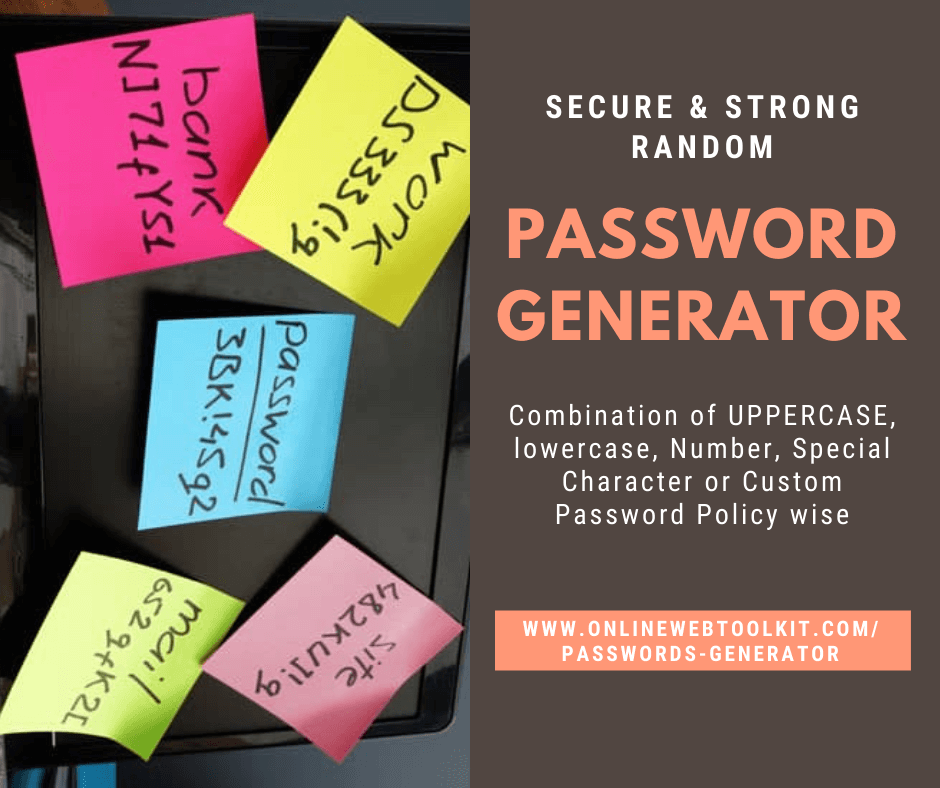
Strong Password Generator: The Complete Guide to Building Unbreakable Passwords
Every account you own is protected by a string of characters. This guide shows you exactly how to make that string strong enough to stop the attacks that break weak ones — and how a strong password generator does the hard part for you.
Strong Password Generator Introduction
A strong password generator is a small piece of software that does one job extremely well: it produces a string of characters that is long, unpredictable, and free of the human habits that make passwords easy to guess. That last part matters more than most people realize. Humans are wonderful at many things, but choosing random characters is not one of them. Left to our own devices, we reach for birthdays, pet names, favorite sports teams, and keyboard patterns like qwerty123 — all of which live at the very top of every password-cracking dictionary in existence.
The idea behind a password generator is simple, but the impact is significant. Instead of asking your brain to invent randomness (something it is genuinely bad at), you hand the job to an algorithm designed specifically for it. The result is a password such as xT9!qL2vR#mK7pWd — a string that means nothing, follows no pattern, and would take a modern computer longer than a human lifetime to guess through brute force, provided it is long and varied enough.
This is exactly the problem our Strong Password Generator at OnlineWebToolkit solves. It runs entirely in your browser, requires no sign-up, and gives you full control over length, character types, and how many passwords you want at once. Whether you are securing a new email account, setting up a banking login, or auditing years of reused passwords across dozens of old accounts, a generator like this removes the guesswork and the bad habits in one step.
Throughout this guide, we will walk through why password strength is not optional in 2026, the exact habits that separate a secure password from a vulnerable one, and how to get the most out of a random password generator as part of a broader security routine. By the end, you will understand not just how to generate a strong password, but why each design decision behind the tool exists in the first place.
Why Strong Passwords Matter
It is tempting to think of a password as a small, forgettable detail — a formality you clear on the way to the thing you actually want to do, whether that is checking email, transferring money, or logging into work systems. In reality, a password is often the only barrier between an attacker and everything you have stored behind it: financial records, private conversations, medical information, photos, and business documents. Weak passwords do not just risk inconvenience; they risk identity theft, drained bank accounts, hijacked social media, and in workplace settings, entire company networks.
The math of brute-force attacks
Modern attackers rarely guess passwords one at a time by hand. Instead, they use software running on powerful hardware, sometimes rented cloud computing clusters, to attempt millions or billions of combinations per second. This is called a brute-force attack, and its effectiveness is a direct function of password length and character variety. Every additional character you add to a password does not just add a little more security — it multiplies the number of possible combinations an attacker must try.
This is why security professionals repeat the same advice: length beats complexity. A 16-character password made of ordinary lowercase words can, in some configurations, be harder to crack than an 8-character password stuffed with symbols. The best strong password generator tools combine both — generous length and full character variety — so you are not forced to choose one advantage over the other.
Data breaches make weak passwords worse
Brute-force attacks are only part of the picture. In practice, most account takeovers do not start with an attacker guessing your password from scratch. They start with a data breach at some unrelated company — a retailer, a forum, a fitness app — where your email and password were stored and then stolen. If that password is one you reused anywhere else, attackers can plug the same combination into banking sites, email providers, and social platforms in an automated process called credential stuffing. This is precisely why password uniqueness across accounts matters as much as password strength itself; a strong password generator that produces unique passwords for every login neutralizes this entire category of attack.
The real-world cost of a compromised password
When an account is compromised, the damage rarely stays contained to that single account. An attacker who gains access to your email can trigger password resets on nearly every other service tied to that address, effectively using one breach as a master key. A compromised work account can expose client data, internal communications, or financial systems, creating liability well beyond the individual user. And for small businesses running lean teams, a single weak admin password can be the difference between a minor inconvenience and a business-ending breach.
Security researchers consistently find that a large share of successful account breaches trace back to passwords that were either too short, too predictable, or reused across multiple services — not sophisticated hacking techniques. The fix is almost always simpler than the attack, and it rarely requires specialized knowledge, expensive software, or ongoing maintenance beyond the initial habit change.
None of this is meant to be alarming for its own sake. It is meant to explain why the few extra seconds it takes to generate and save a strong, unique password are consistently one of the highest-value security habits available to any internet user, regardless of technical skill level.
Why this matters more, not less, in 2026
Computing power available to attackers continues to grow, and cloud-based cracking services have made high-performance hardware accessible to far more people than in years past, including those with limited technical skill and modest budgets. At the same time, the number of accounts an average person maintains keeps climbing, from banking and email to streaming, shopping, fitness tracking, and workplace tools. Each additional account is another potential entry point, and each one is only as strong as the weakest password protecting it. The combination of cheaper cracking power and a larger personal attack surface is exactly why password habits that felt "good enough" a decade ago no longer hold up, and why tools that remove human guesswork from the process have become more relevant, not less.
Want to Create a Safe Password? Apply These Tips
If you prefer to build a password by hand rather than generating one automatically, it is possible to do it safely — but it requires deliberately working against your own instincts. The tips below are the same principles our generator applies automatically, laid out so you can apply them manually when needed, such as when creating a master password for a password manager.
1. Aim for length before anything else
Set a personal minimum of 12 characters, and treat 16 as your real target for anything sensitive. Length is the single biggest lever you have over crack time, and it costs you nothing extra to remember if you build the password around a memorable structure rather than a random jumble.
2. Mix character types, but don't force awkward patterns
Combine uppercase letters, lowercase letters, numbers, and symbols. Avoid the common trap of simply appending "1!" to the end of a familiar word — attackers' cracking dictionaries already account for that exact habit. Distribute the variety throughout the password instead of clustering it at the start or end.
3. Avoid anything tied to your identity
Names, birthdays, anniversaries, pet names, and addresses are the first things attackers try, often pulled directly from social media. If a determined stranger could learn it about you in five minutes of searching, it does not belong in a password.
4. Skip keyboard patterns and sequences
Strings like asdfgh, 123456, and qazwsx feel random because your fingers move in an unfamiliar way, but they are among the most commonly guessed passwords in every major breach dataset. Cracking tools test these patterns first, not last.
5. Never reuse a password across accounts
This is the tip most people acknowledge and then quietly ignore. Reuse is convenient right up until one of those accounts is breached — at which point every account sharing that password becomes exposed simultaneously.
6. Use a passphrase as a memorable alternative
If you need to type or remember a password without help, a passphrase of four or five unrelated words — such as Cobalt-Ferry-Whistle-Nine! — combines strong length with genuine memorability. Add a number and symbol to strengthen it further, and avoid famous quotes or lyrics, which are predictable to cracking software trained on common phrases.
All six of these principles are applied automatically every time you use a proper strong password generator — no manual effort, no risk of accidentally falling back into old habits.
Password Security Tips
Creating a strong password is the first step, but password security is really an ongoing practice, not a one-time task. The habits below extend protection beyond the moment you hit "generate" and into how you store, share, and maintain your credentials over time.
Store passwords in a manager, never in plain text
Sticky notes, unencrypted spreadsheets, and phone notes apps are all common storage methods — and all of them are trivial for anyone with brief physical or digital access to your device to read. A dedicated password manager encrypts your entire vault behind one master password, so your dozens of unique, generated passwords stay protected even if your device is lost or compromised.
Turn on two-factor authentication everywhere it's offered
A strong password dramatically reduces the odds of a successful attack, but two-factor authentication (2FA) adds a second, independent barrier — typically a code sent to your phone or generated by an authenticator app. Even if a password is somehow exposed, 2FA can stop the takeover before it happens.
Check whether your accounts have already been exposed
Breach-monitoring services let you check whether an email address has appeared in a known data breach. If you discover a match, treat it as an immediate signal to change that password — and any other account still sharing it.
Never share passwords over chat, email, or text
Messaging platforms are not designed for secure credential storage, and messages can linger in chat histories, backups, or forwarded threads long after the original context is forgotten. If you must share access with a teammate or family member, use the secure sharing feature built into most password managers instead.
Give every account its own password
This tip appears more than once in this guide for a reason — it is the single habit that most directly limits the blast radius of any individual breach. A strong random password generator makes this genuinely painless, since you never need to invent or remember the password yourself.
Review and rotate credentials for critical accounts periodically
You do not need to change every password on a fixed schedule, but it is worth periodically reviewing your most sensitive accounts — email, banking, and any account that could be used to reset others — and rotating credentials if they are old, weak, or possibly exposed.
Dive Deep Into Password Best Practices
The tips so far cover the essentials. This section goes a level deeper into the concepts behind password strength — the ideas that security professionals, IT administrators, and password manager developers actually design around.
Understanding entropy
Password strength is formally measured in a unit called entropy, expressed in bits. Entropy reflects how many possible combinations a password could represent given its length and character set — the higher the entropy, the larger the haystack an attacker has to search. A random 12-character password drawn from uppercase, lowercase, numbers, and symbols has dramatically higher entropy than a 12-character password built from a dictionary word plus a few predictable substitutions (like swapping "a" for "@"), even though both are the same length. This is why security tools evaluate randomness, not just character count.
| Password type | Length | Approx. entropy | Relative strength |
|---|---|---|---|
| Common word + number | 8 | ~20 bits | Very weak |
| Word with substitutions | 10 | ~35 bits | Weak |
| Four-word passphrase | 24 | ~51 bits | Moderate |
| Randomly generated (mixed set) | 12 | ~78 bits | Strong |
| Randomly generated (mixed set) | 16 | ~104 bits | Very strong |
Why true randomness is hard for humans
Cognitive science research on human-generated randomness consistently shows the same pattern: people avoid repetition, favor certain digits and letters, and unconsciously fall into rhythmic or familiar sequences, even when explicitly trying to be random. This is not a character flaw — it is simply how human pattern-recognition works. Software does not share this limitation. A properly implemented password generator draws from a cryptographically secure random number source, meaning each character is selected independently and unpredictably, with no bias toward patterns a human brain would gravitate to.
The role of character set size
Every character type you allow into a password — lowercase letters, uppercase letters, digits, symbols — expands what's called the character set. A password using only lowercase letters draws from a set of 26 possible characters per position. Add uppercase and digits, and that grows to 62. Add symbols, and it can exceed 90. Because entropy grows exponentially with set size and length combined, even modest increases in character variety produce outsized gains in overall strength.
Predictable substitution patterns don't fool modern cracking tools
Many people believe swapping letters for lookalike numbers or symbols — "password" becoming P@ssw0rd — meaningfully strengthens a password. In practice, cracking software has accounted for these substitutions for years; dictionary-based attacks routinely test the "leetspeak" variant of every common word alongside the original. A substitution-based password can look complex to a human eye while remaining nearly as guessable as the original word to an automated tool.
Context-specific password requirements
Not every account needs the same treatment. A throwaway account for a one-time newsletter signup carries far less risk than your primary email or banking login, and it is reasonable to calibrate effort accordingly. That said, generating a strong, unique password takes the same few seconds regardless of the account's importance, so many security-conscious users simply apply strong, unique passwords everywhere by default rather than trying to rank accounts by risk.
Security standards bodies such as NIST have shifted their guidance in recent years to emphasize length and screening against known-breached password lists over forced complexity rules and mandatory periodic changes — reflecting decades of real-world breach data on what actually stops attackers.
How much should you trust a strength meter?
Most signup forms show a strength meter that shifts from red to yellow to green as you type. These meters are useful directional guides, but their underlying scoring logic varies significantly from one website to another, and a handful still reward simple tricks, like adding a trailing digit, with a misleadingly high score. Treat any strength meter as a rough signal rather than a guarantee, and rely on the actual generation method behind a password, not just the color of a bar, for real confidence. A password produced by a proper random generator at 16 characters or more will score well on virtually any reasonably designed meter, which is one more reason generation beats manual invention.
Common Password Mistakes to Avoid
Most weak passwords are not the result of carelessness so much as small, understandable shortcuts that add up. Recognizing these patterns in your own habits is often the fastest way to close real security gaps.
- Recycling a "strong" password across accounts. A single well-built password loses all of its strength advantage the moment it's reused, because a breach anywhere exposes it everywhere.
- Using predictable incremental changes. Updating Summer2025! to Summer2026! when prompted to change a password follows a pattern attackers actively test for.
- Storing passwords in browser autofill without a master password. Convenient, but risky on shared or unlocked devices, and often not encrypted to the same standard as a dedicated manager.
- Answering security questions honestly and publicly. Your mother's maiden name or first pet is often discoverable through public records or old social media posts, undermining account recovery flows meant to be a safety net.
- Ignoring breach notification emails. These alerts are one of the few direct signals you get that a password needs to change immediately, and they are easy to dismiss as spam.
- Writing passwords on physical notes near your workstation. Common in office environments, and one of the simplest ways for an on-site threat to bypass every other security control you have.
- Choosing password length based on the site's minimum requirement. Minimums exist as a floor, not a target — treat 12 characters as a starting point, not a goal.
- Assuming a longer password is automatically a stronger one. Length helps enormously, but only when it's paired with genuine randomness; a 20-character phrase built from your own name repeated several times is still far weaker than a 12-character machine-generated string.
Password Generator vs. Password Manager
These two tools are often mentioned together, and for good reason — they solve complementary problems. Understanding the difference helps you use both effectively instead of assuming one replaces the other.
| Aspect | Password Generator | Password Manager |
|---|---|---|
| Primary job | Creates a new random password | Stores and organizes existing passwords |
| When you use it | At the moment of account creation or password reset | Every time you log in |
| What it protects against | Weak, predictable, or reused passwords | Forgotten passwords and insecure storage |
| Requires an account? | Usually no | Typically yes, protected by a master password |
| Best used | Paired with a manager for long-term storage | Paired with a generator for strong initial passwords |
In practice, the most effective workflow combines both: use a strong random password generator to create a unique password for each new account, then store that password inside a password manager so you never need to memorize or retype it. This pairing removes the two biggest reasons people give for weak passwords in the first place — difficulty creating one and difficulty remembering it. Over time, this combination also makes routine account maintenance far less stressful, since auditing, updating, or rotating a credential becomes a matter of generating a fresh password and letting the manager handle the rest, rather than trying to invent and memorize something new under pressure.
Key Features of Our Strong Random Password Generator
Our Strong Password Generator was built around a simple principle: give people full control over password strength without requiring any technical knowledge to use it correctly. Here is what sets it apart.
Adjustable length
Choose anywhere from short passwords for low-risk logins to 32+ character passwords for maximum-security accounts, controlled with a simple slider.
Full character control
Toggle uppercase letters, lowercase letters, numbers, and symbols independently to match any site's specific password requirements.
Ambiguous character exclusion
Optionally remove easily-confused characters like l, 1, O, and 0 for passwords you may need to type manually.
Client-side generation
Passwords are generated directly in your browser and are never transmitted to or stored on any server, keeping the entire process private.
Instant strength feedback
A built-in strength indicator shows you in real time how resistant your generated password is to common cracking methods.
Bulk generation
Generate multiple unique passwords in a single pass — useful when setting up several new accounts or performing a household-wide password refresh.
One-click copy
Copy any generated password to your clipboard instantly, ready to paste directly into a signup form or password manager.
No sign-up required
The tool is completely free and accessible with no account creation, subscription, or personal information required.
How to Use the Strong Random Password Generator Tool
Generating a secure password takes less time than reading this sentence. Here is the exact process, step by step.
- Open the tool. Go to onlinewebtoolkit.com/passwords-generator in any browser, on desktop or mobile. No installation or account is required.
- Set your desired length. Use the slider to choose how many characters you want. For most accounts, 16 characters offers a strong balance of security and compatibility with site requirements.
- Select character types. Toggle on uppercase letters, lowercase letters, numbers, and symbols. Leave all four enabled unless a specific site restricts certain characters.
- Exclude ambiguous characters if needed. If you may need to type the password manually rather than paste it, enable the option to remove easily-confused characters like l, 1, and I.
- Generate the password. Click the generate button to instantly produce a new random password. Check the strength meter to confirm it meets your target strength level.
- Copy and save it securely. Use the one-click copy button to place the password on your clipboard, then paste it directly into the account signup form and into your password manager for safekeeping.
- Generate additional passwords as needed. Repeat the process for every new account. Since each password is generated independently, you never risk accidental reuse.
Ready to build a stronger password?
Generate a secure, unique password in seconds — free, private, and no sign-up required.
Open the Password GeneratorBeyond Passwords: Layering Your Account Security
A strong password is the foundation of account security, not the entire structure. Treating it as one layer among several gives you meaningfully better protection than relying on password strength alone.
Two-factor and multi-factor authentication
Enabling 2FA means that even a leaked or guessed password is not enough on its own to access your account. Authenticator apps are generally considered more secure than SMS-based codes, since text messages can be intercepted through SIM-swapping attacks in targeted cases.
Recovery methods deserve the same care as passwords
Account recovery options — backup emails, recovery phone numbers, security questions — are often the weakest link in an otherwise strong setup. Review these periodically, keep them current, and avoid recovery questions with publicly discoverable answers.
Device-level security
A strong password on an account accessed from an unlocked, unencrypted device offers limited protection. Use a device passcode or biometric lock, keep software updated, and be cautious about staying permanently logged in on shared or public computers.
Awareness of phishing
No password, however strong, protects you if you are tricked into entering it on a fake login page. Always verify the URL before entering credentials, and treat unexpected password-reset emails or urgent security alerts with healthy skepticism until verified through official channels.
Strong unique password + password manager + two-factor authentication + phishing awareness is, together, one of the most effective and accessible personal security setups available to anyone, regardless of technical background.
How Long Should Your Password Be, by Account Type?
Not every login carries the same stakes, and it is reasonable to calibrate password length and effort to what an account actually protects. The table below offers a practical starting point, though using maximum length everywhere is never a mistake.
| Account type | Recommended length | Notes |
|---|---|---|
| Primary email | 16–20 characters | Often the recovery point for every other account; treat as highest priority. |
| Online banking / finance | 16–20 characters | Combine with 2FA and monitor for unusual login alerts. |
| Password manager master password | 20+ characters or a long passphrase | This single password protects every other credential you own, so it deserves the most care and should never be reused anywhere. |
| Social media accounts | 14–16 characters | Frequently targeted for impersonation and scam campaigns. |
| Work / business systems | 16+ characters, per company policy | Follow organizational password policy; a compromised work account can expose colleagues and clients. |
| Shopping and retail sites | 12–14 characters | Often store saved payment methods, making them worth protecting even though they feel low-stakes. |
| Low-risk / one-time signups | 12 characters | Still generate uniquely; never reuse even for accounts that feel disposable. |
The pattern across every row is the same: the more an account can be used to reach other accounts, or the more financially or personally sensitive its contents, the more length and care it deserves. Because a strong password generator produces long, high-entropy passwords in the same click regardless of target length, there is rarely a practical reason to default to shorter passwords even for lower-stakes accounts.
Glossary of Password Security Terms
A short reference for the terminology that comes up throughout password security discussions, useful if you are new to the topic or sharing this guide with someone who is.
Entropy
A measurement, in bits, of how unpredictable a password is. Higher entropy means more possible combinations an attacker would need to test, and therefore a longer realistic crack time.
Brute-force attack
An automated attempt to guess a password by systematically trying combinations, often at extremely high speed using specialized hardware.
Dictionary attack
A faster variant of brute-force cracking that tests known words, common passwords, and their predictable variations before resorting to full random guessing.
Credential stuffing
An attack technique where usernames and passwords leaked from one breach are automatically tested against other websites, exploiting password reuse.
Two-factor authentication (2FA)
A login process requiring a second form of verification beyond a password, typically a time-limited code from an app or text message.
Passphrase
A password built from multiple unrelated words rather than a single word or random string, designed to be both long and easier for a human to remember.
Salting and hashing
Techniques websites use to store passwords securely: hashing transforms a password into a scrambled, irreversible value, while salting adds random data to each password before hashing so that identical passwords produce different stored values.
Credential vault
The encrypted storage area within a password manager where all of your saved passwords and related information are kept, accessible only through your master password.
Frequently Asked Questions
How long should a strong password be?
A strong password should be at least 12 characters long, though 16 or more is safer for important accounts like email and banking. Length matters more than complexity because it exponentially increases the number of guesses an attacker needs to make before finding the right one.
Is a random password generator safe to use?
Yes, provided it runs the generation process locally in your browser rather than sending your inputs to a server. Our generator never transmits or stores the passwords it creates — each one exists only on your device until you choose to save it elsewhere.
Should I use the same strong password for multiple accounts?
No. Every account should have its own unique password. Reusing even a very strong password means that if one service is breached, every other account sharing that password becomes vulnerable through credential stuffing attacks.
Do I need special characters in a strong password?
Special characters help expand the character set and increase entropy, but length and true randomness matter more overall. A long, randomly generated password combining uppercase, lowercase, numbers, and symbols offers the strongest realistic protection.
How often should I change my passwords?
Current security guidance no longer recommends changing strong, unique passwords on a fixed schedule. Instead, change a password immediately if the service reports a breach, if you reused it elsewhere in the past, or if you suspect it has been exposed in any way.
What is the difference between a password generator and a password manager?
A password generator creates a new random password on demand. A password manager securely stores, organizes, and autofills all your passwords behind one encrypted master password. The two work best when used together.
Can a strong password still be hacked?
No password is theoretically unbreakable, but a sufficiently long, random, and unique password can push the realistic time required for a brute-force attack well beyond any practical timeframe, making other attack methods, like phishing, far more likely threats than direct guessing.
Is it safe to let my browser generate and save passwords?
Built-in browser password tools have improved significantly and are far better than reusing weak passwords, but a dedicated password manager typically offers stronger encryption standards, cross-platform support, and features like breach monitoring that most browsers do not fully match.
Final Thoughts
Password strength is one of the few areas of personal cybersecurity where the effort required is genuinely small compared to the protection gained. A single click on a strong password generator replaces years of accumulated weak habits — reused passwords, predictable patterns, and easily guessed personal details — with something an attacker has no realistic path through.
Pair a strong, unique password for every account with a password manager to store them and two-factor authentication to back them up, and you will have built a security posture that covers the overwhelming majority of real-world account takeover attempts. Start with the accounts that matter most — email, banking, and any account tied to your identity — and work outward from there.
Generate your next strong password now
Free, private, and ready in one click.
Try the Strong Password Generator