

Hexadecimal (Hex) Number To Decimal, Octal, Binary Number Conversion Online Tool
Hexadecimal (Hex) Number To Decimal, Octal, Binary Number Converter
Provide Hexadecimal (Hex) [0-9 and A-F] Number To Decimal, Binary, Octal Number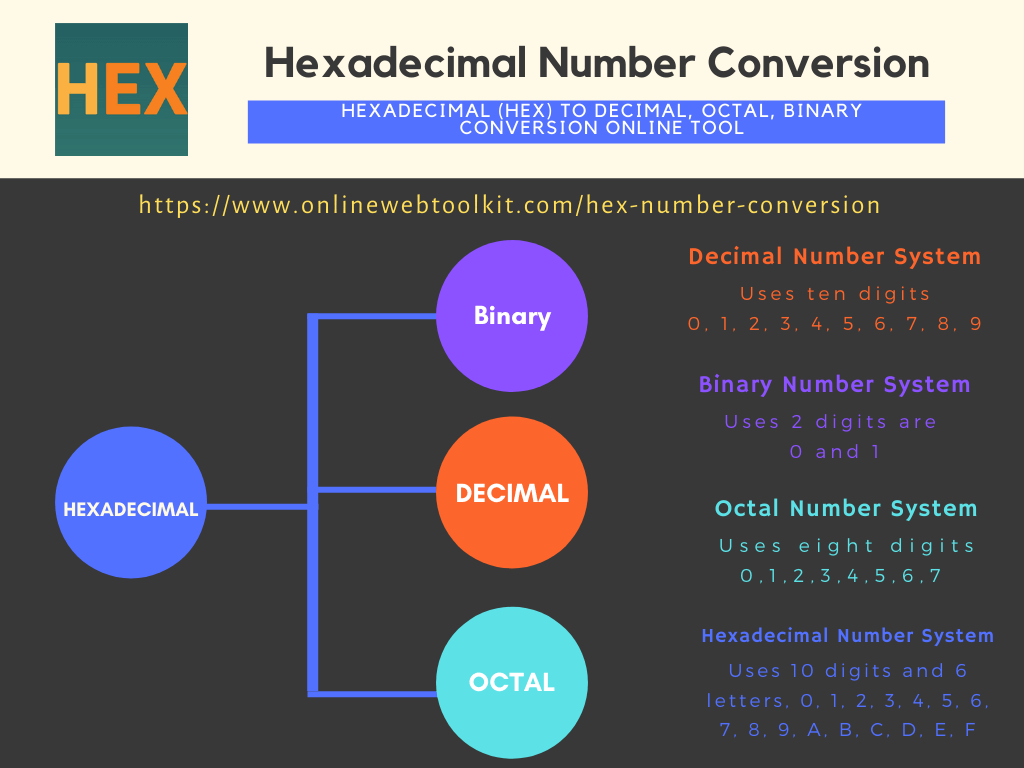
Hexadecimal to Decimal, Octal, and Binary Conversion: The Complete Guide
Decode the shorthand programmers rely on every day. Learn how to convert hex numbers into decimal, octal, and binary by hand, step by step, and get instant results with our free online converter.
01Introduction
If you've spent any time in a debugger, inspected a CSS color code, or looked at a crash report, you've almost certainly seen hexadecimal — the base-16 number system that has become the de facto shorthand for binary data across nearly all of modern computing. Values like 0x7FFE1A3C or #C0294B might look cryptic at first glance, but they're built on the same simple positional logic as the decimal numbers you use every day.
Hexadecimal earned its dominance for a very practical reason: a single byte (8 bits) fits perfectly into exactly two hex digits, with no rounding, no remainder, and no awkward grouping. That clean 4-bit-per-digit relationship is why hex shows up everywhere from memory addresses to color values to cryptographic hashes — and why knowing how to convert hex to decimal, hex to octal, and hex to binary is such a genuinely useful skill for anyone working in or around technology.
This guide covers everything you need: what number systems are, how decimal, binary, octal, and hexadecimal each work with worked examples, the exact manual steps for converting hex into the other three bases, a handy reference conversion table, common mistakes to avoid, and how to use our free Hexadecimal Number Conversion Tool to get fast, accurate results whenever you need them.
Fig 1.1 — The hexadecimal value 9C expressed in decimal, octal, and binary
Whether you're a developer decoding a memory address, a designer working with hex color codes, or a computer science student encountering base-16 arithmetic for the first time, this guide is written to take you from the underlying theory all the way through to fast, confident, real-world application.
02What Are Number Systems?
A number system (or numeral system) is a defined way of representing quantities using a specific set of digit symbols and positional rules. Every number system has a base (or radix), which determines how many unique digit symbols exist before the system rolls over into a new position. Understanding a system's base is the key to understanding everything else about how it works.
Hexadecimal has a base of 16, meaning it uses sixteen digit symbols: 0 through 9, followed by the letters A through F to represent the values 10 through 15. Once you count past F, you roll over into a new position, exactly the way decimal rolls over from 9 into 10. This rolling-over behavior, known as positional notation, applies identically across decimal, binary, octal, and hexadecimal; only the base and the available digit symbols change from system to system.
The Positional Value Formula
For any number system with base b, a number's value is found by multiplying each digit by the base raised to a power based on its position, then summing the results together:
This single formula underlies every conversion technique covered later in this guide. Apply it with base 16 and you're converting hex to decimal; apply it with base 2 or base 8, and you're doing the identical thing for binary or octal. You're not learning four separate systems — you're applying one consistent rule, just with a different base each time.
Why Hexadecimal Became the Standard Shorthand
Modern computer architecture is built almost universally around the byte — a fixed unit of 8 bits. Since 16 equals 2⁴, a single hexadecimal digit represents exactly 4 bits (a "nibble"), which means a full byte fits perfectly into exactly two hex digits with zero rounding. Octal, by contrast, groups bits in sets of 3, which doesn't divide evenly into 8-bit bytes — a mismatch that made octal progressively less convenient as byte-based architectures became the industry standard through the 1970s and beyond. Hexadecimal's clean, exact relationship to byte-aligned data is the single biggest reason it dominates modern computing shorthand today.
Decimal (Base-10)
The everyday human counting system, used to display hex conversion results in a familiar format.
Binary (Base-2)
The native language of digital circuits — every hex digit maps to exactly four binary bits.
Octal (Base-8)
Groups bits in sets of three; historically useful, now mostly seen in Unix file permissions.
Hexadecimal (Base-16)
Our focus in this guide — the dominant modern shorthand for binary, aligned perfectly with 8-bit bytes.
03Decimal Number System
The decimal number system, or base-10 system, is the numeral system nearly everyone learns first, used daily for counting, money, and measurement. It relies on ten digit symbols — 0 through 9 — with each position representing a power of 10.
Decimal is the format we typically convert hexadecimal values into whenever we want an immediately recognizable result. Let's break down the decimal number 4,721 to see positional notation at work:
When we convert hex to decimal later in this guide, we're using this exact same positional-value approach, just substituting powers of 16 in place of powers of 10 during the expansion step, then summing to reach a familiar decimal total.
04Binary Number System
The binary number system is a base-2 system using only two digits, 0 and 1, called bits. Binary matters enormously in this guide because hexadecimal's entire reason for existing is its exact, tidy relationship to binary — every hex digit maps to precisely four binary bits, a shortcut covered in full detail in the conversion steps section below.
Binary is positional just like decimal, except each place value doubles moving left, since the base is 2. Take the binary number 1011:
Fig 4.1 — Bit positions and their corresponding powers of 2 for binary number 1011
Binary strings grow long fast — representing decimal 156 requires eight bits (10011100). This rapid growth is exactly why hexadecimal shorthand exists: it packs the same information into just two compact digits (as we'll see shortly), making it dramatically easier for a human to read, write, and communicate accurately.
05Octal Number System
The octal number system is a base-8 system using eight digits: 0 through 7. Because 8 equals 2³, every octal digit maps to an exact group of three binary bits. This 3-bit grouping is important context in this guide, because it explains why converting hex directly to octal requires a two-step bridge through binary rather than a simple digit-for-digit lookup — hex's 4-bit grouping and octal's 3-bit grouping simply don't align.
Let's convert the octal number 452 into decimal using positional notation with base 8:
Octal saw heavy use in early computing but has largely been overtaken by hexadecimal in modern systems, since hex aligns cleanly with 8-bit bytes while octal does not. Octal's most visible surviving use today is Unix and Linux file permissions, such as in the command chmod 755.
06Hexadecimal Number System
The hexadecimal number system ("hex") is a base-16 system — the central focus of this entire guide. Since only ten numeric digit symbols exist (0–9), hexadecimal borrows the letters A through F to represent the values 10 through 15, keeping every digit position exactly one character wide.
| Decimal | Hex Digit |
|---|---|
| 10 | A |
| 11 | B |
| 12 | C |
| 13 | D |
| 14 | E |
| 15 | F |
Because 16 equals 2⁴, every hex digit corresponds exactly to a group of 4 binary bits (a "nibble"), and two hex digits together represent exactly one full byte (8 bits) — a perfectly clean, rounding-free relationship that makes hex the natural language for describing raw binary data. Let's convert the hexadecimal value 2F into decimal:
Hex is everywhere once you know to look for it: CSS color codes like #C0294B, memory addresses in a debugger like 0x7FFE1A3C, MAC addresses like 3C:22:FB:9A:1E:0D, and cryptographic hashes like a SHA-256 checksum are all written in hexadecimal because it's the most compact, exact, byte-aligned way to represent raw binary data for human eyes.
07Steps for Converting Hexadecimal to Decimal, Octal, and Binary (Manually)
Converting hexadecimal into decimal, binary, and octal uses three distinct techniques. Hex to decimal uses the positional-value (sum of powers) method. Hex to binary uses a direct digit-expansion shortcut, since each hex digit maps to exactly 4 bits. Hex to octal is best done as a two-step bridge through binary, since hex's 4-bit grouping and octal's 3-bit grouping don't line up directly. All three are covered below with fully worked examples.
Method 1: Hexadecimal to Decimal (Positional Value Method)
- Write out each hex digit along with its position, counting from right to left starting at position 0.
- Convert any letter digits (A–F) to their numeric equivalents (10–15) first.
- Multiply each digit by 16 raised to the power of its position.
- Sum all the results together to get the final decimal value.
Example 1: Convert Hexadecimal 9C to Decimal
This matches the value we've referenced throughout this article series — a good confirmation that the positional formula holds true regardless of which base you're converting from.
Method 2: Hexadecimal to Binary (Direct Digit-Expansion Shortcut)
Because hex is base-16 and 16 = 2⁴, converting hex to binary requires no arithmetic at all beyond a simple lookup: each hex digit expands directly into its own unique 4-bit binary group.
- Take each hex digit individually, working left to right.
- Convert each digit into its 4-bit binary equivalent (using values 0000 through 1111).
- Concatenate the groups in order to form the final binary number.
- Drop unnecessary leading zeros from the very first group only, if desired.
Example 2: Convert Hexadecimal 9C to Binary
This lookup-and-combine process is why hex-to-binary conversion is so fast in practice — there's no multiplication, no division, and no risk of arithmetic slip-ups, just direct substitution using the 16-row lookup table covered in the conversion table section below.
Method 3: Hexadecimal to Octal (via Binary Bridge)
Since hexadecimal groups bits in sets of 4 and octal groups bits in sets of 3, there's no direct digit-for-digit shortcut between the two. The cleanest, most reliable method is a two-step bridge: first convert hex to binary (Method 2 above), then regroup that same binary string into sets of 3 bits to read off the octal digits.
- Convert the hexadecimal number to binary first, using the 4-bit expansion shortcut from Method 2.
- Re-pad the resulting binary string with leading zeros if needed so its total length divides evenly into groups of 3.
- Split the binary number into groups of three bits, working from right to left.
- Convert each 3-bit group into its equivalent single octal digit (0–7).
Example 3: Convert Hexadecimal 9C to Octal
Let's verify with an independent check: hex 9C equals decimal 156 (calculated earlier). Converting octal 234 back to decimal gives 2×64 + 3×8 + 4×1 = 128 + 24 + 4 = 156 — confirming our bridge conversion is accurate.
Fig 7.1 — Hexadecimal 9C converted three ways, showing the binary bridge to octal
A Larger, Combined Example: Hexadecimal C8E
As a final check, octal 6216 converts back to decimal as 6×512 + 2×64 + 1×8 + 6×1 = 3072 + 128 + 8 + 6 = 3214, exactly matching our hex-to-decimal result — confirming every conversion path in this example agrees with the others.
Converting Hexadecimal Fractions
Hexadecimal numbers with a fractional part convert to decimal using negative powers of 16 for each digit right of the hex point.
For hex-to-binary fractional conversion, the same 4-bit digit expansion shortcut from Method 2 applies directly to digits after the hex point, with no extra arithmetic required.
A Quick Practice Drill
The fastest way to internalize these shortcuts is repetition with small numbers before moving on to longer hex strings. Try converting each of the following hexadecimal values to decimal, binary, and octal using the methods covered in this guide, then check your answers against our conversion table or the online tool: 1D, 4A, and FF. Working through even a handful of practice values by hand — rather than jumping straight to the calculator — builds the kind of intuitive number sense that makes reading a memory dump, debugging a color value, or working through a networking exam question feel natural instead of tedious.
As a general rule of thumb, once you can convert a single hex digit to its 4-bit binary group without consciously thinking through the math, you've essentially memorized the core lookup table that underlies almost every fast hex conversion technique used by working developers and network engineers.
08Hex / Decimal / Octal / Binary Conversion Table
A quick-reference conversion table is one of the most useful things to keep bookmarked when you're reading a hex dump, debugging code, or studying for an exam. Below is a table covering hexadecimal values 0 through 14 (decimal 0–20), alongside their decimal, binary, and octal equivalents. Keeping this range close at hand covers the majority of everyday lookups you'll need in coursework, debugging sessions, and technical documentation.
| Hexadecimal | Decimal | Binary | Octal |
|---|---|---|---|
| 0 | 0 | 0000 | 0 |
| 1 | 1 | 0001 | 1 |
| 2 | 2 | 0010 | 2 |
| 3 | 3 | 0011 | 3 |
| 4 | 4 | 0100 | 4 |
| 5 | 5 | 0101 | 5 |
| 6 | 6 | 0110 | 6 |
| 7 | 7 | 0111 | 7 |
| 8 | 8 | 1000 | 10 |
| 9 | 9 | 1001 | 11 |
| A | 10 | 1010 | 12 |
| B | 11 | 1011 | 13 |
| C | 12 | 1100 | 14 |
| D | 13 | 1101 | 15 |
| E | 14 | 1110 | 16 |
| F | 15 | 1111 | 17 |
| 10 | 16 | 10000 | 20 |
| 11 | 17 | 10001 | 21 |
| 12 | 18 | 10010 | 22 |
| 13 | 19 | 10011 | 23 |
| 14 | 20 | 10100 | 24 |
Look closely at the single hex digits (0–F) alongside their 4-bit binary equivalents (0000–1111) — this sixteen-pair mapping is the single most useful thing to memorize, since it's the exact lookup table behind the digit-expansion shortcut covered earlier in this guide. Once these sixteen pairs are second nature, converting long hex strings into binary becomes almost mechanical.
09Real-World Applications of Hexadecimal Number Conversion
Hexadecimal conversion is one of the most practically useful number-system skills in modern technology. Here's where converting hex to decimal, binary, or octal shows up in everyday practice.
Software Debugging & Memory Addresses
Every debugger, disassembler, and crash report displays memory addresses and register values in hexadecimal, because it's the most compact and exact way to represent raw binary data. Understanding hex-to-decimal conversion helps developers quickly sanity-check values while stepping through code.
Web Design & CSS Colors
Every hex color code you've used in a stylesheet — like #C0294B — represents the red, green, and blue intensity values of a color, each ranging from 0 to 255 in decimal (00 to FF in hex). Designers frequently convert between hex codes and RGB decimal values when fine-tuning a palette.
Cryptography & Checksums
Hash functions like MD5 and SHA-256 output long hexadecimal strings, since hex is the most compact, unambiguous way to represent raw binary hash data. Cryptographic keys, digital certificates, and file checksums are almost universally displayed in hexadecimal for the same reason.
Networking
MAC addresses are displayed in hexadecimal pairs (like 3C:22:FB:9A:1E:0D), and IPv6 addresses are written entirely in hexadecimal, since it compactly represents the much larger 128-bit address space compared to IPv4's decimal notation.
Programming Language Number Literals
Most modern programming languages support hexadecimal literals directly in source code using a 0x prefix, such as 0x9C in Python, JavaScript, C, and Java alike — a nearly universal convention that makes hex the most portable and widely recognized non-decimal number format across languages.
Assembly Language & Machine Code
When reverse engineers or low-level programmers examine compiled machine code, opcodes and operands are almost always displayed in hexadecimal, since it maps directly onto byte boundaries without the visual noise of long binary strings. Understanding hex-to-binary conversion is essential for anyone working directly with assembly language or analyzing how compiled instructions map onto actual CPU operations.
Fig 9.1 — Hexadecimal conversion in real-world technology contexts
10Common Mistakes to Avoid When Converting Hexadecimal Numbers
- Forgetting to convert letter digits before doing arithmetic. A, B, C, D, E, and F represent 10 through 15 respectively — plugging the letter directly into the positional formula instead of its numeric value will produce an incorrect result.
- Trying to convert hex to octal without going through binary. Because hex groups bits in sets of 4 and octal groups bits in sets of 3, there's no direct digit-for-digit shortcut. Skipping the binary bridge step is one of the most common errors beginners make.
- Forgetting to re-pad after bridging through binary. Once you've expanded hex digits into 4-bit binary groups, you often need to add leading zeros before regrouping into 3-bit sets for octal — skipping this step misaligns every group boundary.
- Mixing up upper and lowercase hex letters inconsistently. Hexadecimal is case-insensitive (9c and 9C represent the same value), but inconsistent formatting can cause confusion or errors in code that expects a specific case convention.
- Confusing a hex literal for a decimal number in code. Without the
0xprefix, a value like10looks identical whether it's meant as decimal ten or hexadecimal sixteen — always double-check the prefix or context before interpreting a number literal. - Skipping verification. Always cross-check your final answer, either by converting it back to hex or by comparing intermediate results (like the decimal value) across different conversion paths, as shown in the worked examples above.
- Misreading similar-looking letters and digits. The hex digit "B" can be mistaken for the number 8 in certain fonts, and "D" can be misread in handwriting. When accuracy matters, such as transcribing a memory address or a hash value, double-check ambiguous characters carefully.
11Why Hexadecimal Rules Computing
Hexadecimal's dominance is a direct consequence of how modern computer hardware evolved. Early machines like the PDP-8 used word sizes built around multiples of 3 bits, making octal the natural shorthand of that era. But as the industry standardized around the 8-bit byte in the 1970s — driven largely by architectures like the Intel 8080 and its successors — a new shorthand was needed that aligned cleanly with 8-bit boundaries. Since 16 = 2⁴, hexadecimal fit perfectly: exactly two hex digits represent one full byte, with no rounding or awkward grouping.
This clean alignment made hex the natural choice for engineers documenting memory maps, hardware registers, and machine code throughout the microprocessor revolution of the late 1970s and 1980s. As personal computing exploded and software development matured, hex carried over into debugging tools, color systems, networking protocols, and cryptography — cementing its position as the default binary shorthand across virtually every corner of computing.
Hexadecimal vs. Octal: Why Hex Won
Both octal and hexadecimal exist for the same fundamental reason — making binary data more readable for humans — but hexadecimal's 4-bit grouping aligns perfectly with byte-based architecture in a way that octal's 3-bit grouping simply cannot match. A single byte splits evenly into two hex digits, but does not split evenly into octal digits, forcing awkward workarounds. This structural advantage, combined with hexadecimal's widespread adoption across programming languages, debugging tools, and documentation standards, is why hex remains the dominant choice today, while octal has been relegated to a smaller set of specialized use cases like Unix file permissions. Understanding both systems, and knowing exactly why one prevailed over the other, gives you a deeper appreciation for the design decisions baked into the technology you use every day.
12Key Features of Our Hexadecimal (Hex) Number To Decimal, Octal, Binary Number Conversion Online Tool
Manual conversion builds real understanding, but when you need a fast, dependable answer, our Hexadecimal Number to Decimal, Octal, Binary Conversion Tool delivers it instantly. Here's what makes it a reliable everyday utility for developers, designers, students, and network engineers alike.
Instant, Real-Time Conversion
Type a hexadecimal number and see its decimal, binary, and octal equivalents update immediately — no page reloads, no waiting.
Multi-Base Support
Convert hex to decimal, binary, and octal all at once, so you don't need three separate tools for three separate bases.
Case-Insensitive Input
Accepts both uppercase and lowercase hex letters (A–F or a–f) without requiring a specific formatting convention.
Free, Private & No Sign-Up
No account, subscription, or installation required. All conversions run directly in your browser with no data stored on our servers.
Mobile-Friendly Design
Fully responsive layout that works smoothly on desktops, tablets, and smartphones, so you can convert values wherever you're working.
One-Click Copy
Copy any converted value straight to your clipboard, ready to paste into your code editor, terminal, or documentation.
Unlike a general scientific calculator that requires manually switching modes to see one base at a time, this tool is purpose-built specifically for cross-base conversion — including the binary-bridge logic needed for accurate hex-to-octal results. That focus means faster, more reliable answers without any of the extra clutter of unrelated calculator functions.
Whether you're a developer decoding a hex dump, a designer fine-tuning a color palette, or a computer science student working through a base-16 assignment, having a dedicated converter saves real time compared to reaching for a general calculator app and hunting for the right mode buried in a menu. It's a small tool, but one that quietly removes friction from a task nearly every technical professional runs into on a regular basis.
13How to Use the Hexadecimal (Hex) Number To Decimal, Octal, Binary Number Conversion Online Tool
Getting a conversion from our Hexadecimal Number to Decimal, Octal, Binary Conversion Tool takes just a few seconds. Here's the full walkthrough:
- Open the tool by visiting onlinewebtoolkit.com/hex-number-conversion in any browser — desktop or mobile.
- Enter your hexadecimal number into the input field, using digits 0–9 and letters A–F (either uppercase or lowercase).
- View the results instantly. The decimal, binary, and octal equivalents appear automatically as you type — there's no separate "Convert" button needed for basic use.
- Copy the value you need using the copy icon next to each result field, ready to paste directly into your project, terminal, or notes.
- Clear and repeat for as many numbers as you need to convert — the tool has no daily limits or usage caps.
Tips for Getting the Most Out of the Tool
A few small habits make the converter even more useful in daily work. Keep it open in a separate browser tab while debugging — it's far faster to paste a raw hex address in and read the decimal or binary equivalent than to work through the positional formula by hand every time you hit a register value or memory pointer. Use it to double-check homework or exam practice by working a conversion out manually first, then verifying your answer against the tool's output before a test. And if you're learning about color theory or CSS, try converting hex color codes into their decimal RGB components to build an intuitive feel for how colors are represented digitally — the tool gives instant feedback while you experiment with different values.
Try the Converter Now
Skip the manual math and get accurate decimal, binary, and octal conversions in seconds.
Open the Free Tool →14Frequently Asked Questions
Convert any letter digits (A–F) to their numeric values (10–15), then multiply each digit by 16 raised to the power of its position and add all the results together. Our free online converter performs this instantly for any hex value.
Expand each hex digit directly into its 4-bit binary equivalent and combine the groups in order. This works because 16 equals 2 to the 4th power, so no arithmetic is required beyond a simple lookup.
Hexadecimal groups binary digits in sets of four while octal groups them in sets of three, so the two don't align digit-for-digit. The reliable approach is to convert hex to binary first, then regroup that binary string into sets of three to read off the octal digits.
A standard hex color code uses two digits each for red, green, and blue intensity, with each pair representing a value from 0 to 255 in decimal, giving six digits total for a full RGB color specification.
No, hexadecimal is case-insensitive, so 9c and 9C represent exactly the same value. Some style guides or codebases prefer one case for consistency, but both are mathematically identical.
Hash functions produce raw binary output, and hexadecimal is the most compact, unambiguous way to display that binary data, since every two hex digits represent exactly one byte, making hashes easy to copy, compare, and log.
The largest 2-digit hexadecimal number is FF, which equals 15×16 + 15, or 255 in decimal — the maximum value a single byte can hold, which is why hex pairs are the standard way to represent byte values.
Yes, the converter is designed to handle large hexadecimal inputs reliably, avoiding the precision loss or manual arithmetic errors that commonly occur when converting long hex strings by hand.
IPv6 addresses are 128 bits long, far larger than IPv4's 32 bits. Hexadecimal represents that space far more compactly than decimal would, which is why IPv6 addresses are written as groups of hex digits separated by colons.
Yes, negative values are typically represented using two's complement notation at the binary level, and the resulting bit pattern is then displayed in hexadecimal for compactness, which is common when viewing negative integers in a debugger.