

HTML Table Code Generator
HTML Table Generator
Use the options below to quickly create your custom HTML table code and ready to use.Your HTML Table Preview
Your custom number of table rows and columns are not reflected in this preview.
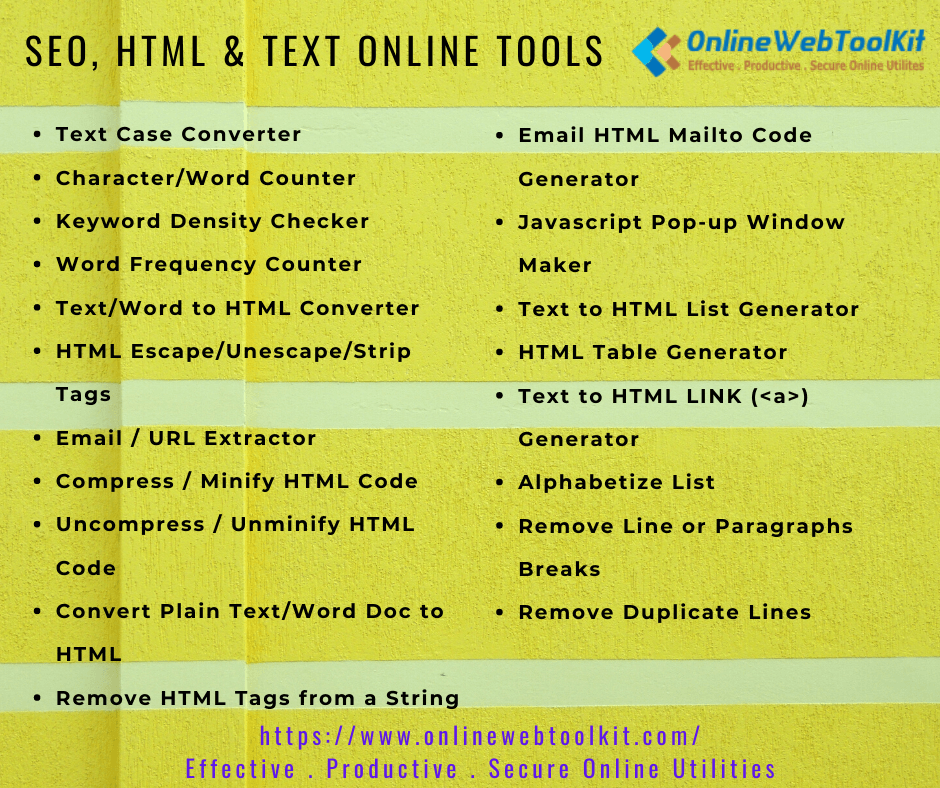
HTML Table Generator Tool
Online HTML Table generator tool quickly create your custom HTML table code based on your set properties.
What Is HTML? Hypertext Markup Language Basics Explained
HTML stands for HyperText Markup Language. HTML is the primary markup language found on the internet. Every HTML page has a series of elements that create the content structure of a web page or application. HTML provides the structure and content of a web page, and it is used in conjunction with other technologies like CSS and JavaScript to make websites dynamic and interactive.
HTML consists of a series of elements and tags, which are used to define the structure and content of a web page. For example, the title of a web page is typically defined using an <h1> tag, and paragraphs of text are defined using the <p> tag. HTML also includes tags for creating lists, links, images, tables, and many other types of content.
The three main parts of an element are:
- Opening tag – used to state where an element starts to take effect. The tag is wrapped with opening and closing angle brackets. For example, use the start tag
to create a paragraph.
- Content – this is the output that other users see.
- Closing tag – the same as the opening tag, but with a forward slash before the element name. For example, </p> to end a paragraph.
The combination of these three parts will create an HTML element:
<p> This is how you add a paragraph in HTML.</p>
Every HTML page uses these three tags:
- <html> tag is the root element that defines the whole HTML document.
- <head> tag holds meta information such as the page’s title and charset.
- <body> tag encloses all the content that appears on the page.
<html> <head> <!-- META INFORMATION --> </head> <body> <!-- PAGE CONTENT --> </body> </html>Other popular block-level tags include:
- Heading tags – these range from <h1> to <h6>, where heading h1 is largest in size, getting smaller as they move up to h6.
- Paragraph tags – are all enclosed by using the <p> tag.
- List tags – have different variations. Use the tag for an ordered list, and use for an unordered list. Then, enclose individual list items using the <li> tag.
HTML has evolved over the years, with new versions being introduced to add new capabilities and improve the language. The latest version of HTML is HTML5, which provides new elements and attributes, improved semantic elements, and better support for multimedia and other types of web-based content.
HTML Table
An HTML table is used to represent data in a tabular format, with rows and columns. It's commonly used to display information in a structured manner. Here's an example of a simple HTML table:
<table> <tr> <th>Header 1</th> <th>Header 2</th> </tr> <tr> <td>Row 1, Column 1</td> <td>Row 1, Column 2</td> </tr> <tr> <td>Row 2, Column 1</td> <td>Row 2, Column 2</td> </tr> </table>
In this example, <table> is the table element, <tr> is the table row element, and <td> is the table data element. The <th> element is used to represent header cells in the table.
You can add many other attributes to a table, such as border size, cell padding, and background color, to make it look more appealing and readable.
You can also apply styles to the table using CSS to make it look more visually appealing.
How To Use This Online HTML Table Code Generator Tool?
The HTML Table Generator we offer is user-friendly and provides a seamless experience for both professionals and beginners. No complex rules or technical know-how is required to utilize this service, making it accessible for everyone. The straightforward steps outlined below will assist you in using our tool to view HTML Table code online.
- Fill the related table properties for generate your HTML Table Generator code.
- As this tool is get data, the results are generated and displayed instantaneously.
- Once you have generated the HTML code, you have a few options for copying and pasting it into your document. One option is to click on the "Copy" button, which will immediately copy the code to your clipboard. Another option is to select all the converted text using your mouse or keyboard (e.g., "Control-A" on Windows or "Command-A" on Mac) and then press "Control-C" to copy it and "Control-V" to paste it back into your document.
- Alternatively, you can download generated HTML code as a text file by simply clicking on the "Download" button.
Useful Features of Our Online HTML Table Code Generator
The Online HTML Table Code Generator on our website comes equipped with exceptional features, making it the best online tool for generate HTML List codes. The most notable features of our online utility are listed below.
Free and Simple to Use
Using this tool is completely free, and it's simple to use with just a few straightforward instructions.
Compatibility
As a cloud-based tool, it's compatible with all operating systems, including iOS, Android, Windows, and Mac OS, so you can access and use it to view HTML files no matter what device you're using.
No Plugin Installation Needed
You can access this tool through the web browser of your device without having to install any plugins. This HTML viewer operates without the need for any plugins, making it convenient to use.
Speedy and Secure
It quickly displays results, and it's a secure online tool that doesn't save any data entered or uploaded by users in its databases.
Global Accessibility
You can access this tool from anywhere in the world as long as your device is connected to the internet.
Privacy Is Guaranteed
OnlineWebToolkit offers a variety of online tools, including an HTML Table Code Generator, and places a high priority on protecting the privacy of its users' data. Many people are concerned about the security of their confidential information when using online tools due to the increase in online scams. However, our website provides a secure tool that keeps your information safe from hackers and will not share it with any third parties. The HTML code you upload to our tool is stored only on your device (in the browser) during the formatting process. Once the results are generated and displayed, or when you refresh or close your browser, the data is deleted from our site.
Choose your dimensions, fill in the cells, and copy properly structured table markup with real header cells.
The structure that makes a table accessible
A table is more than rows of cells. The elements that carry meaning are <thead>, <tbody> and <tfoot> for grouping, <th> for header cells, scope="col" or scope="row" to say which cells a header governs, and <caption> to name the table.
The consequence of getting this wrong is concrete. A screen reader reading a properly marked-up table announces the relevant column and row header with each cell, so the user hears "Revenue, Q3, 4.2 million" rather than "4.2 million" with no context. A table whose header row is made of <td> elements is, structurally, a table with no headers at all.
Merging cells without breaking the grid
colspan makes a cell span columns, rowspan makes it span rows. The rule people forget is that a spanned cell occupies the grid positions it covers, so the rows it reaches into must have correspondingly fewer cells. Get the arithmetic wrong and the table renders with a ragged edge or an extra column that appears from nowhere.
Use merging sparingly. Complex spanned tables are difficult to navigate with a screen reader even when the markup is correct, and two simple tables are almost always clearer than one elaborate one.
Tables are for data, not layout
Using tables to position page elements was standard practice until CSS layout matured, and there is no reason to do it now. Flexbox and grid do the job with less markup, they reflow properly on small screens, and they do not tell assistive technology that your navigation is a data table.
For genuine data tables, the one responsive concern is width. A wide table on a phone will either overflow the page or squash into unreadability. The standard solution is to wrap it in a container with overflow-x: auto so the table scrolls horizontally inside the page rather than forcing the whole page to scroll.
Frequently Asked Questions
Should every table have a caption?
It is good practice. The caption is the table's accessible name, so a user navigating by table hears what each one contains before deciding to read it. If the surrounding heading already names the table clearly, a visually hidden caption is a reasonable compromise.
How do I make a table responsive?
Wrap it in a div with overflow-x: auto so it scrolls inside the page. Restructuring a table into stacked cards on mobile is possible with CSS but usually destroys the row-to-row comparison that made the data a table in the first place.
Can I sort a table by clicking a header?
Not with HTML alone - sorting requires JavaScript. If you add it, mark the sortable headers with aria-sort so screen reader users know the current sort state.
More HTML tools
Every tool below runs in your browser, with nothing uploaded. The HTML tools hub also carries a full reference guide to HTML itself — elements, attributes, entities, semantics, forms and accessibility.